CRM Software for Modeling Agencies: How Predictive Insights Could Shape Agency Decisions
In a modeling agency, this could involve analyzing information such as previous casting submissions, booking history, client preferences, talent availability, project categories, and response patterns.
Modeling agencies generate a significant amount of information every day. Talent profiles, casting requests, submissions, auditions, client preferences, availability, bookings, and communication records can all create valuable data. However, collecting this information is only the beginning. The bigger opportunity is using it to understand patterns and support better decisions.
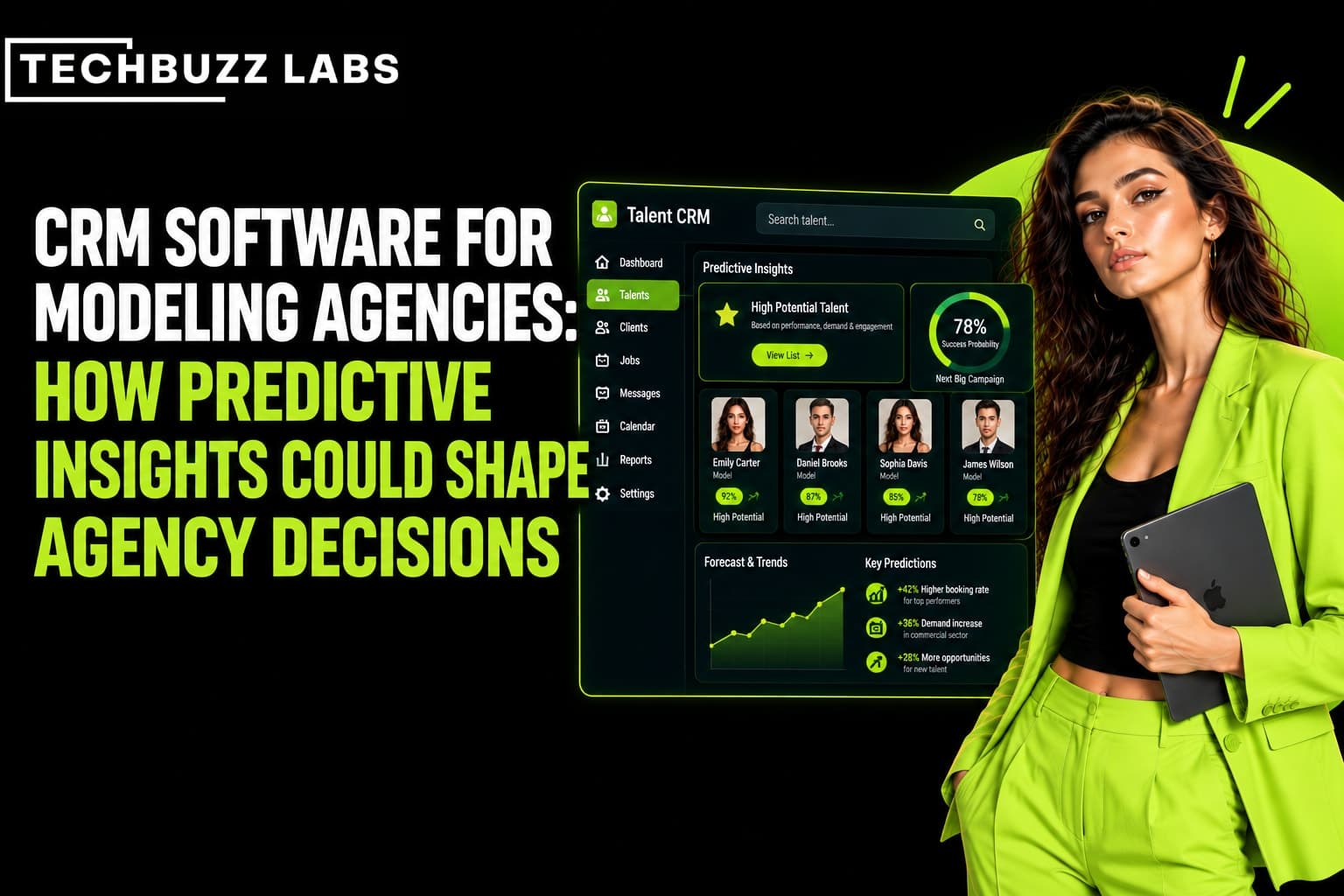
CRM Software for Modeling Agencies can provide the foundation for this approach. When a CRM organizes historical agency data and combines it with analytics and predictive capabilities, agencies can potentially identify patterns before making important operational decisions.
For modeling agencies across the USA, including agencies working in New York, Los Angeles, Miami, Chicago, and Atlanta, predictive insights could help teams understand their talent pool, prioritize opportunities, improve client relationships, and make more informed decisions about future casting and bookings.
What Are Predictive Insights?
Predictive insights use historical and current data to identify patterns that may help anticipate future outcomes.
For example, if an agency has historical data showing that certain talent profiles frequently perform well for particular types of campaigns, that information could help agents prioritize similar profiles when a new opportunity arrives.
Predictive insights do not guarantee what will happen in the future. Instead, they provide additional information that can help professionals make better-informed decisions.
Why Predictive Insights Matter for Modeling Agencies
As a modeling agency grows, the amount of operational data can become difficult to analyze manually.
An agency may have hundreds or thousands of talent profiles and a long history of casting opportunities. Agents may know individual models and clients well, but it becomes harder to recognize larger patterns across the entire business.
CRM Software for Modeling Agencies can centralize this information and make it easier to analyze.
Predictive capabilities can then help management move beyond simply asking what happened and begin exploring questions such as what patterns are emerging, which opportunities may deserve more attention, and where the agency could improve its workflow.
Predicting Talent Demand
One potential application is understanding future talent demand.
An agency can analyze historical casting activity to identify which types of talent clients frequently request. For example, data may show increasing demand for certain experience levels, skills, locations, or project categories.
These patterns can help agencies make more informed decisions about talent acquisition and roster development.
Instead of expanding the talent pool based only on assumptions, managers can use historical demand as one factor when deciding what types of talent the agency may need in the future.
Improving Talent Matching
Predictive insights can also support talent matching.
When a new casting request arrives, a CRM can compare the requirements with existing talent information and historical casting activity.
For example, the system may identify models who match the project requirements and have previously received positive client responses for similar opportunities.
This can give agents a more informed starting point when building a shortlist.
The objective is not to automatically select a model. Experienced agents still need to consider portfolio quality, client expectations, personality, professionalism, and the creative requirements of each project.
Predictive information simply provides another layer of useful context.
Understanding Booking Patterns
Booking history can reveal important trends about an agency's business.
A CRM can record which talent are booked, which types of projects generate bookings, which clients return for additional work, and how casting opportunities move through the agency's pipeline.
Over time, these records can help managers identify recurring patterns.
For example, an agency may discover that certain clients frequently book talent during particular periods or that specific project categories consistently produce stronger booking rates.
These insights can support future planning and resource allocation.
Forecasting Client Activity
Client relationships are an important part of modeling agency growth.
Predictive analysis can potentially help agencies identify patterns in client behavior by examining previous inquiries, casting requests, submissions, bookings, and communication activity.
An agency may discover that some clients consistently generate repeat opportunities while others have become less active.
This information can help account managers decide where follow-up or relationship-building efforts may be most valuable.
The goal is not to treat clients as simple numbers. Instead, data can provide additional context for building stronger professional relationships.
Identifying High-Value Opportunities
Not every casting opportunity has the same potential value for an agency.
An agency may receive many requests while having limited time and resources to manage them. Historical data can help managers understand which types of opportunities tend to produce successful outcomes.
For example, a casting category with consistently strong booking results may deserve closer attention than an opportunity type that historically produces very few conversions.
Predictive insights can therefore help agencies prioritize their workflow without relying entirely on intuition.
Predicting Talent Availability Challenges
Availability is another area where historical information can provide useful insights.
A model who is frequently involved in bookings may have limited availability during certain periods. If an agency manages a large roster, it can become difficult to anticipate these scheduling challenges manually.
A connected CRM can bring availability, bookings, and casting information together.
This can help agents identify potential scheduling conflicts earlier and consider alternative talent when responding to client requests.
Finding Casting Workflow Bottlenecks
Predictive analysis is not limited to talent and bookings. It can also be applied to internal agency operations.
For example, historical CRM data may reveal that certain stages of the casting workflow regularly experience delays.
An agency might discover that availability confirmation takes too long, client feedback is often delayed, or submissions require excessive manual processing.
Identifying these patterns can help management decide where workflow automation or process improvements could have the greatest impact.
Making Better Decisions With CRM Dashboards
Predictive insights become more useful when managers can understand them easily.
CRM dashboards can bring key agency metrics into one place and help teams monitor trends over time. Depending on the system, managers may review casting activity, submission rates, booking performance, client activity, talent availability, and other operational indicators.
Instead of manually collecting reports from different team members, management can use centralized information to evaluate agency performance.
This can make regular decision-making more efficient and give leadership a clearer view of the business.
How TechBuzzLabs Can Support Predictive CRM Workflows
TechBuzzLabs focuses on custom technology designed around the specific workflows of businesses. For modeling and talent agencies, this can mean connecting talent profiles, casting opportunities, client information, availability, submissions, and bookings within one centralized platform.
A custom CRM Software for Modeling Agencies can provide the structured data foundation needed for advanced reporting, analytics, automation, and future predictive capabilities.
Rather than forcing an agency to adapt its operations around a generic system, a custom solution can be designed around the agency's actual processes and information requirements.
This can make it easier to build dashboards and data workflows that are relevant to how the agency manages talent and clients.
Predictive Insights Should Support Human Expertise
Predictive technology can be valuable, but modeling remains a relationship-driven and creative industry.
Data cannot completely understand every factor involved in selecting talent. A client's changing creative direction, an agent's knowledge of a model, personal relationships, professionalism, and the overall fit of a talent for a campaign can all influence a decision.
For this reason, predictive insights should be treated as decision-support tools.
The strongest approach combines data with human expertise. Agents can use patterns and recommendations to focus their attention while retaining control over the final decision.
Preparing for a More Data-Driven Agency
Agencies that want to benefit from predictive insights need to start with reliable data.
Talent profiles should be kept accurate. Casting activity should be consistently recorded. Submissions, client responses, auditions, bookings, and availability should be connected whenever possible.
The better organized the underlying information is, the more useful future analytics and predictive capabilities can become.
This makes a modern CRM more than a place to store contact information. It can become a long-term data foundation for the agency.
Conclusion
Predictive insights could change how modeling agencies use the information they generate every day. By analyzing casting history, talent performance, client activity, availability, and booking patterns, agencies can identify trends that may help them make more informed decisions.
CRM Software for Modeling Agencies provides the centralized foundation needed to organize this information and turn it into useful operational insights.
For U.S. modeling agencies, predictive capabilities could support better talent matching, demand planning, client management, opportunity prioritization, and workflow improvement. However, technology should complement rather than replace the experience of professional agents.
TechBuzzLabs can help agencies create custom CRM workflows that connect their talent, casting, client, and booking data in one system. As agencies become more data-driven, having organized information today can create a stronger foundation for analytics and predictive decision-making tomorrow.
The future of modeling agency management is not simply about collecting more data. It is about understanding that data and using it to make smarter decisions at the right time.